I built an interactive map of the Materials Project database and wanted to share it in case it’s useful to anyone, and to get feedback, especially from MP staff on whether I’ve read the data correctly.
Site: Materials Coverage Atlas
Code (MIT): GitHub - cboler/materials-coverage-atlas: Interactive d3.js coverage atlas of the Materials Project database · GitHub
What it is
All 154,377 entries from MP v2026.09.28, embedded in 2D with UMAP over composition and property features (~100 traits). Points are colored by a rule-based screening category (structural, energy, electronic/optical, magnetic, unclassified), and you can switch to overlays that show where coverage is thin:
- Elastic-data coverage: which entries have bulk/shear moduli and which don’t
- Distance from stiffness data: how far a stiffness prediction would have to extrapolate (a coverage indicator, not a prediction)
- Experimental vs. theoretical, element cost, crustal abundance
- Newer entries: whether entries added since ~2020 land in sparse or crowded parts of feature space
There’s also a parallel-coordinates view with brushing (band gap, formation energy, hull energy, moduli, cost, abundance) linked to the map, with “no data” and “unphysical” slots on each axis so gaps and broken elastic fits are easy to find. Each point links back to its MP page.
The finding that prompted it
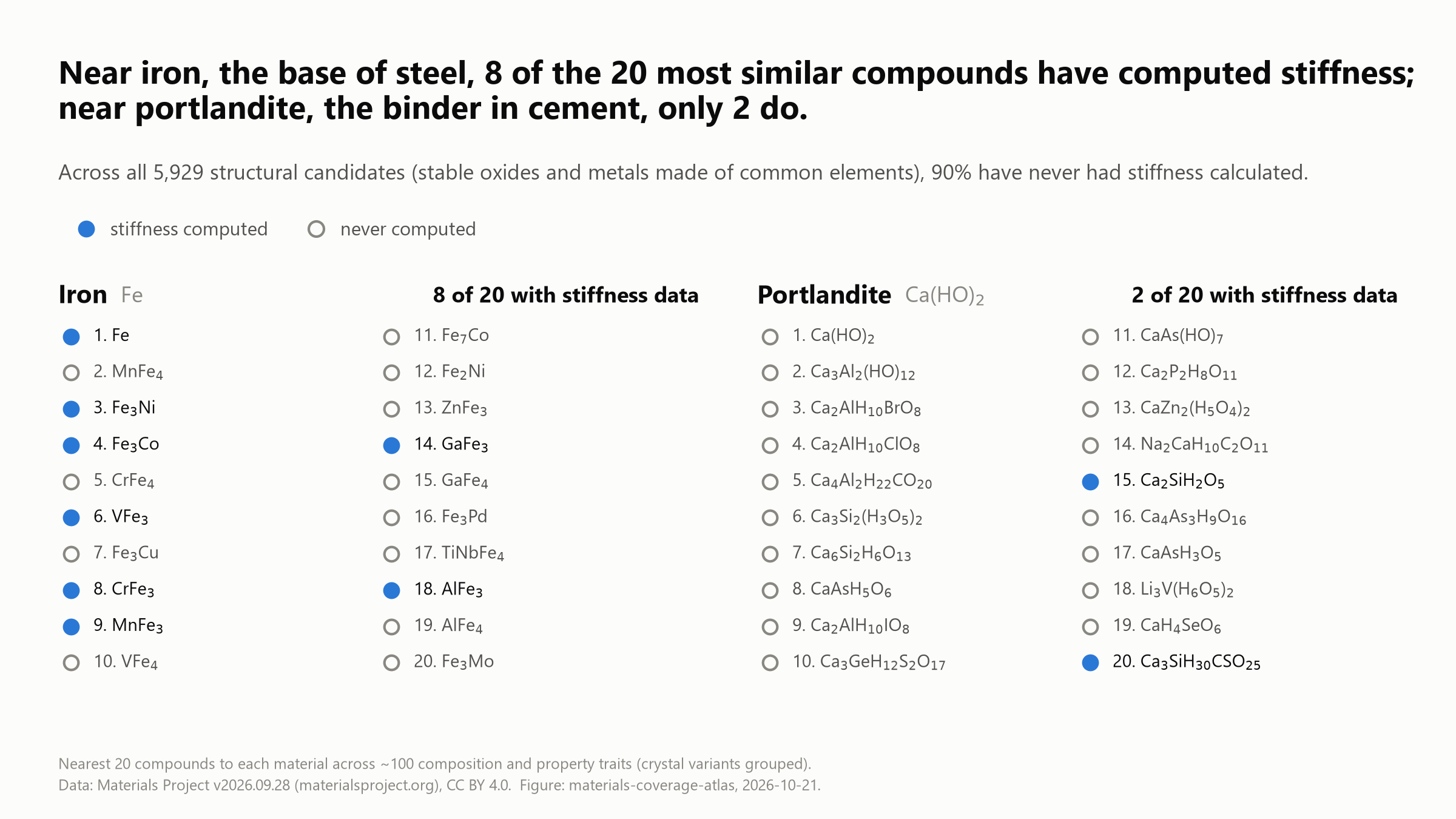
Near iron, 8 of the 20 most similar compounds have computed elastic tensors. Near portlandite (the binder in cement), only 2 do, and the neighbors are cement hydrates like katoite and Friedel’s salt. Across 5,929 “structural candidates” (stable, earth-abundant oxides and metals), about 90% have no stiffness data. That’s not a criticism; elastic calculations are expensive. But it might help prioritize, or warn ML users how far their training data really reaches.
Caveats
- Categories are screening heuristics on GGA/GGA+U values, not property predictions. The rules are documented in the app and in
pipeline/categories.py. - The battery-electrode rule was checked against MP’s insertion electrodes: ~86% recall within a 0.05 eV/atom hull window, ~50% precision against an approximate negative set.
- The site is static: the data was pulled once through the API and committed, so it doesn’t hit the API on page load.
- Not affiliated with or endorsed by MP. Data is CC BY 4.0, with attribution and the database version on every page.
Questions for the MP team
- Since most
created_atdates are bulk-rebuild stamps, I order entries by their old numeric ID as a proxy for when they were added. Is there a better field for entry age? - Is there a public per-entry marker of ML-pipeline origin? I couldn’t find one.
- Is there any planned elastic-tensor work on hydrates or cement phases? Happy to share the list of uncovered neighbors if it’s useful.
Feedback on the rules, the map, or anything I’ve gotten wrong is very welcome.