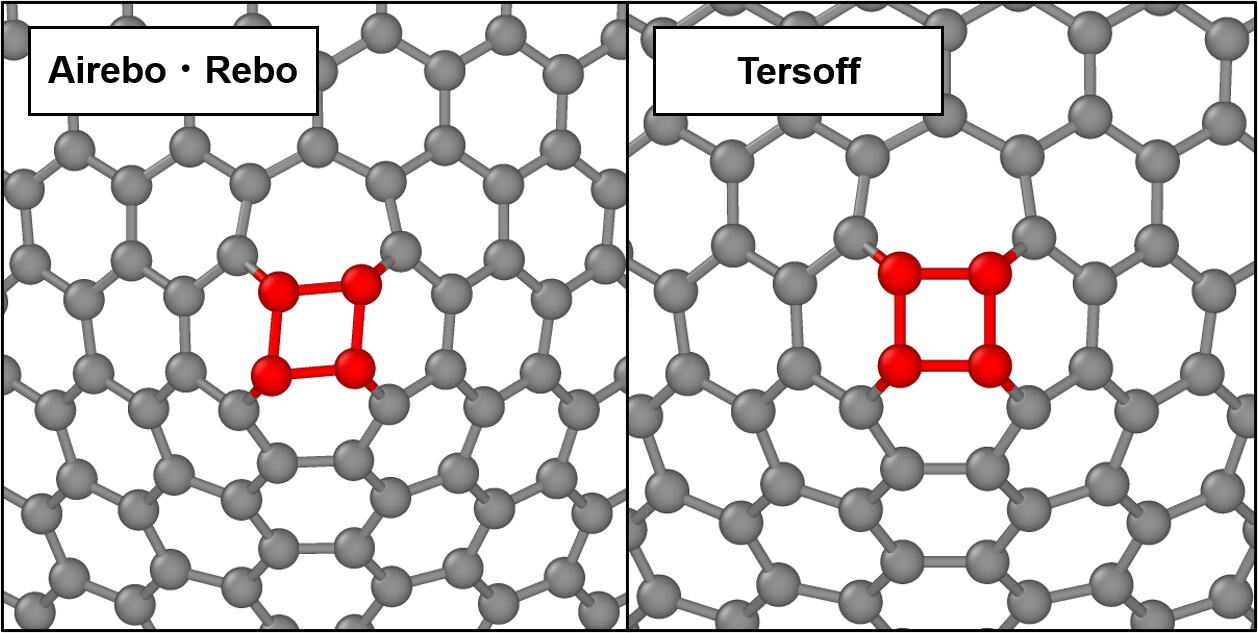
I compared the energy minimization of a graphene structure containing a coupled 4–7 ring defect using Tersoff, REBO, and AIREBO. The system contains 4,441 carbon atoms.
The initial coordinates of the four-membered ring are:
These four atoms initially form a planar square with a side length of approximately 1.1594 Å.
The common input settings were:
units metal
dimension 3
boundary m m m
atom_style atomic

read_data 4000graphene_4-7.data
mass 1 12.011

neighbor 2.0 bin
neigh_modify every 1 delay 0 check yes

thermo 100
thermo_style custom step pe fnorm fmax

min_style cg
minimize 1.0e-23 1.0e-8 5000000 50000000
For Tersoff, I used:
pair_style tersoff
pair_coeff * * SiCGe.tersoff C
For AIREBO, I used:
pair_style airebo 3.0 1 1
pair_coeff * * CH.airebo C
With Tersoff, the four-membered ring retains an approximately rectangular shape with angles close to 90°. With AIREBO, it distorts into a rhombic shape with angles of approximately 80° and 100°. A separate REBO-only calculation produced a similar distortion.
I understand that the four-membered ring is highly strained and that the initial square is not necessarily stable. However, I would like to understand why REBO/AIREBO produces this symmetry-breaking distortion in the 4–7 defect, while Tersoff retains a nearly rectangular structure.
Is this an expected difference between the REBO and Tersoff potential-energy surfaces?
LAMMPS version: 22 Jul 2025
Operating system: Linux
This is impossible to say from remote without a thorough analysis and also comparison to quantum calculations.
There are two possible contributing factors:
AIREBO/REBO uses in part tabulated spline functions which are more noisy than the analytical potential functions of Tersoff and thus may result in small differences due to rounding and floating point not being associative.
AIREBO/REBO and Tersoff use different cutoffs those may contribute to the discrepancy.
I would also make a test using small random displacements to determine if the symmetric structure is conservative or just a saddle point and stable only by chance. Also, from the image it is not clear if the structure stays flat or buckles.
Thank you for your advice. I performed several additional tests.
After applying small random perturbations and relaxing the structure, AIREBO consistently produced one of two equivalent rhombic configurations, with an out-of-plane distortion of approximately 0.03 Å. In contrast, Tersoff relaxed to a square configuration.
I also calculated the energies of 15 fixed structures by varying the four-membered-ring angle from 76° to 104° in 2° increments while keeping its center and side length fixed. AIREBO showed minima near 80° and 100°, whereas Tersoff and Quantum ESPRESSO/PBE calculations showed a minimum near 90°.
At the AIREBO minima, the short diagonal is approximately 2.00 Å, which coincides with the upper C–C cutoff in AIREBO/REBO. As a sensitivity test, I temporarily increased rcmax_CC from 2.00 Å to 2.25 Å and found that the ring relaxed to a nearly square configuration.
Does this result support the interpretation that the rhombic minimum is strongly related to the cutoff treatment in AIREBO? Also, is changing rcmax_CC alone a meaningful diagnostic test, or should related cutoff and spline parameters be modified consistently?
I would encourage you that the tests you are running seem sensible, and your choice of probing sensitivity to parameters is the right thing to do in trying to understand this phenomenon.
One small piece of advice: in LAMMPS you can dump a full snapshot of positions and forces, and you can usefully compare those to a DFT benchmark. You can also calculate the Hessian matrix with dynamical_matrix command — LAMMPS documentation (at considerable cost, but still a static calculation) for further characterisation.
I’m not giving this advice as a domain expert in many body potentials – simply giving suggestions to get more “bang for your buck” from cheaper static snapshots instead of an expensive dynamical trajectory. The conclusions you are drawing seem reasonable to (non-expert) me.