Hi all,
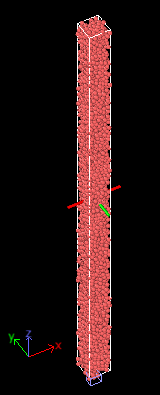
I notice some non-physical behavior in my DEM jamming simulation and I wonder if it had anything to do with the bin size. For reference, my granular system (surrounded by periodic walls) is shown below and I compress it beyond the RCP volume fraction by using fix deform to shrink in the direction along the red and green plane (x and y). The top and bottom (z) along the direction perpendicular to compression is just periodic.
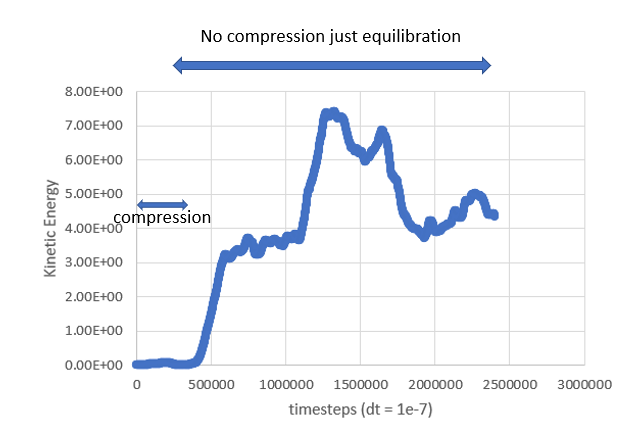
When compressed beyond the RCP threshold, I get a very high pressure, but the kinetic energy does not dissipate even with a tangential friction contact when let to equilibrate. I instead get oscillatory behavior that I don’t have an explanation for… I expect friction to dissipate this energy and the granular velocities to eventually die down to very low values (Kinetic energy of individual granules ~ < 1e-10J). When I use viscous damping, the kinetic energy momentarily goes down but shoots back up when viscosity is removed so it doesn’t help.
I wonder if it has anything to do with the number of bins… My granules have radii between 0.0045m and 0.005m and the length of the channel is 0.05m x 0.05m x 1m, therefore there are slightly more than 5 granules per length of the box in x and y direction, and 100 granules in the z-direction.
I get the following bins: binsize = 0.0149999 → bins = 4 4 67 when I use neighbor 0.02 bin. I noticed that I get the following info:
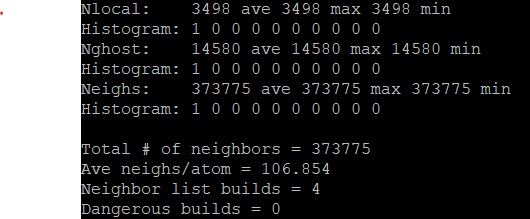
The ave neighs/atom is really large and it should ideally be close to 6 and not 106… But when I don’t use neighbor 0.02 bin, I get a smaller binsize and more bins, and a more realistic neighs/atoms of 5.3:
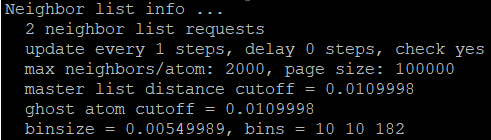
If I build the neighbor list regularly, say like 10 timesteps, will the inclusion of the neighbor command just mean more computation time but would give the same result? Also, how does binsize affect in a serial run?
At the end of a sufficiently large timestep for the case with neighbor command, I get total kinetic energy as 7.0970525J and when its not being used I get 7.095222J so it looks like I get nominally the same result. I am worried if I’m not there are some force pairs that are going undetected resulting in the lack of decrease of kinetic energy?
I’ve attached the kinetic energy and pressure as a function of timesteps to show what I get but I don’t reach near 0 kinetic energy even after playing around with simulation parameters
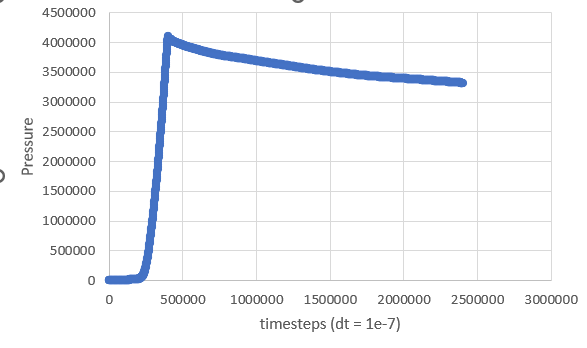
My input file is as follows, and I’ve attached my data file:
units si
atom_style  	sphere
boundary 	pp pp pp
newton  	off
comm_modify 	vel yes
read_data	n_0p63_periodic_mid.sim
[n_0p63_periodic_mid.sim|attachment](upload://uiyoCBKz1QPQVOquHk0itnLhBWJ.sim) (934.1 KB)

[n_0p63_periodic_mid.sim|attachment](upload://uiyoCBKz1QPQVOquHk0itnLhBWJ.sim) (934.1 KB)


log 			n_0p63_periodic.lammps


#neighbor 	0.02 bin
neigh_modify 	delay 0

pair_style      gran/hertz/history 8.424908425E+10 NULL 0 0 0.05 0

pair_coeff	* *

timestep 	1e-7
fix  		1 all nve/sphere
fix 11 all viscous 5


region 		atom_region block 0 0.05 0 0.05 0 1
region 		atom_region2 block 0.005 0.045 0.005 0.045 0.05 0.8
group 		atoms region atom_region
group		atoms2 region atom_region2


compute        peratom atoms stress/atom NULL pair
compute        p atoms reduce sum c_peratom[1] c_peratom[2] c_peratom[3]
compute        p1 atoms reduce sum c_peratom[4] c_peratom[5] c_peratom[6]
variable       press equal -(c_p[1]+c_p[2]+c_p[3])/(3*0.05*0.05*1)#((y[896]-1e+5)-(y[895]+1e+5))*((z[893]-1e+5)-(z[894]+1e+5)))
variable       stress_ratio equal c_p[1]/c_p[2]


compute        peratom2 atoms2 stress/atom NULL pair
compute        p2 atoms2 reduce sum c_peratom2[1] c_peratom2[2] c_peratom2[3]
compute        p12 atoms2 reduce sum c_peratom2[4] c_peratom2[5] c_peratom2[6]
variable       press2 equal -(c_p2[1]+c_p2[2]+c_p2[3])/(3*0.04*0.04*0.75)#((y[896]-1e+5)-(y[895]+1e+5))*((z[893]-1e+5)-(z[894]+1e+5)))
variable       stress_ratio2 equal c_p2[1]/c_p2[2]


compute  	rot_kin all erotate/sphere # rotational kinetic energy of the spherical particles

variable myvfrac equal 0.001575126176137/vol#0.005040275060683/vol
thermo_style 	custom step atoms ke c_rot_kin v_press v_press2 c_p[1] c_p[2] c_p[3] c_p2[1] c_p2[2] c_p2[3] vol v_myvfrac
thermo  	1000
thermo_modify 	lost ignore norm no # atom number non-constant
dump myDump all atom 10000 n_0p63_periodic.atom


run  		200000 # final longer run

unfix 11

fix 111 all viscous 0

run 	        0

fix 1111 all deform 1 x vel -0.01 y vel -0.01

run 		400000

unfix 1111

run 2000000


write_data      n_0p63_periodic.sim