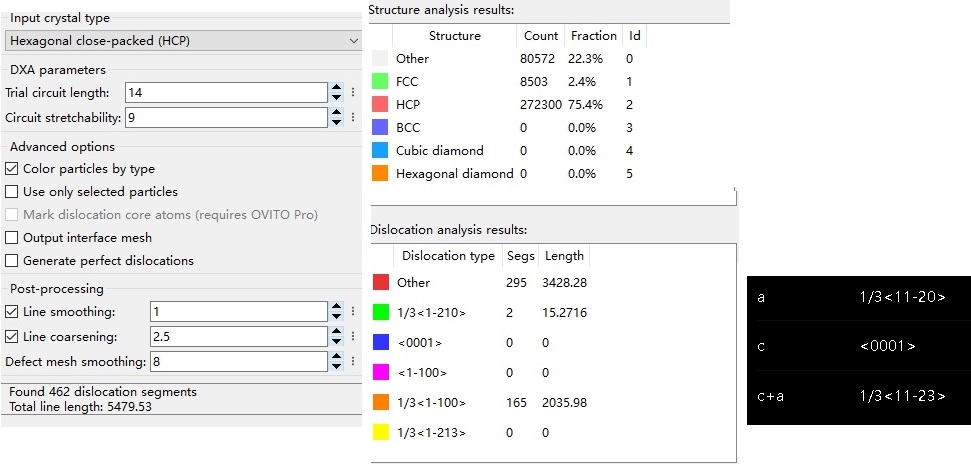
In conventional crystallography, Burgers vectors in HCP crystals are commonly classified into several categories: the a-type Burgers vector is 1/3<11-20>, the c-type Burgers vector is <0001>, the a+c-type Burgers vector is 1/3<11-23>, and additional vectors such as 1/3<10-10> are frequently encountered during dislocation dissociation.
However, when HCP metals are analyzed using the Dislocation Analysis (DXA) module in OVITO, the CA file defines and recognizes only five Burgers vector families: 1/3<1-210>, 1/3<1-100>, <1-100>, <0001>, and 1/3<1-213>. Instead of explicitly classifying dislocations into the conventional a-, c-, and a+c-type categories, OVITO adopts a different Burgers family representation.
I would like to understand the correspondence between the Burgers vector families defined in OVITO and the conventional HCP Burgers vectors described in crystallography textbooks. In particular, I would like to know why OVITO adopts this representation instead of the standard a-, c-, and a+c-type classification commonly used in the literature.
Thanks for the detailed question — the good news is that there’s no actual mismatch here. OVITO’s five HCP dislocation families are the conventional a-, c-, and (a+c)-type dislocations; they’re just written with a different permutation of the four Miller–Bravais indices.
Remember that the angle brackets ⟨…⟩ denote a family of symmetry-equivalent directions, not one specific vector. Because [1-210] is simply a permutation of [11-20], the notations ⟨1-210⟩ and ⟨11-20⟩ describe the exact same set of six directions. The same holds for the others. Here is the correspondence:
OVITO label
Textbook label
Character
1/3⟨1-210⟩
1/3⟨11-20⟩
perfect a
⟨0001⟩
⟨0001⟩
perfect c
1/3⟨1-213⟩
1/3⟨11-23⟩
perfect a+c
1/3⟨1-100⟩
1/3⟨10-10⟩
basal Shockley partial
⟨1-100⟩
⟨10-10⟩
full prismatic vector, b = a√3
So your dissociation partials 1/3⟨10-10⟩ are captured by the 1/3⟨1-100⟩ family, the a-type by 1/3⟨1-210⟩, and a+c by 1/3⟨1-213⟩.
As for why the labels differ: OVITO computes each dislocation’s Burgers vector in the Cartesian frame of the reference lattice and then converts it to four-index notation, reducing to the smallest integers and using a fixed convention for the index order (it places the −2 component in a consistent slot). That produces a mathematically identical vector, just permuted relative to the ordering common in textbooks. The “True Burgers vector” shown for each segment is the actual converted vector, and the colored family it’s assigned to is the symmetry class it belongs to.