N.B. The problem is solved by taking co-ordinates of atom ids 6, 9 and 2049 in the final.txt file. Now I am getting 0.169 eV migration barrier just like the literature.
I am trying to calculate the interstitial migration energy of Ni by transforming a [100] dumbbell to a [010] dumbbell on {100} plane. I am creating the dumbbell by shifting a Ni atom to x or y direction by 30% of the lattice parameter. Next, I’m creating a new Ni atom that is equally spaced out from the lattice site on the opposite direction. For making both [100] and [010] configuration, I am using the perfect Ni structure and then placing the interstitial atom in it.
After creating the dumbbells, I am minimizing the both systems with the following commands:
min_style 	cg
minimize 	1e-15 1e-15 5000 5000
These are the snapshots of the initial and the final configs (the numbers on the atoms are the corresponding atom ids, where 2049 being the newly created Ni atom) -
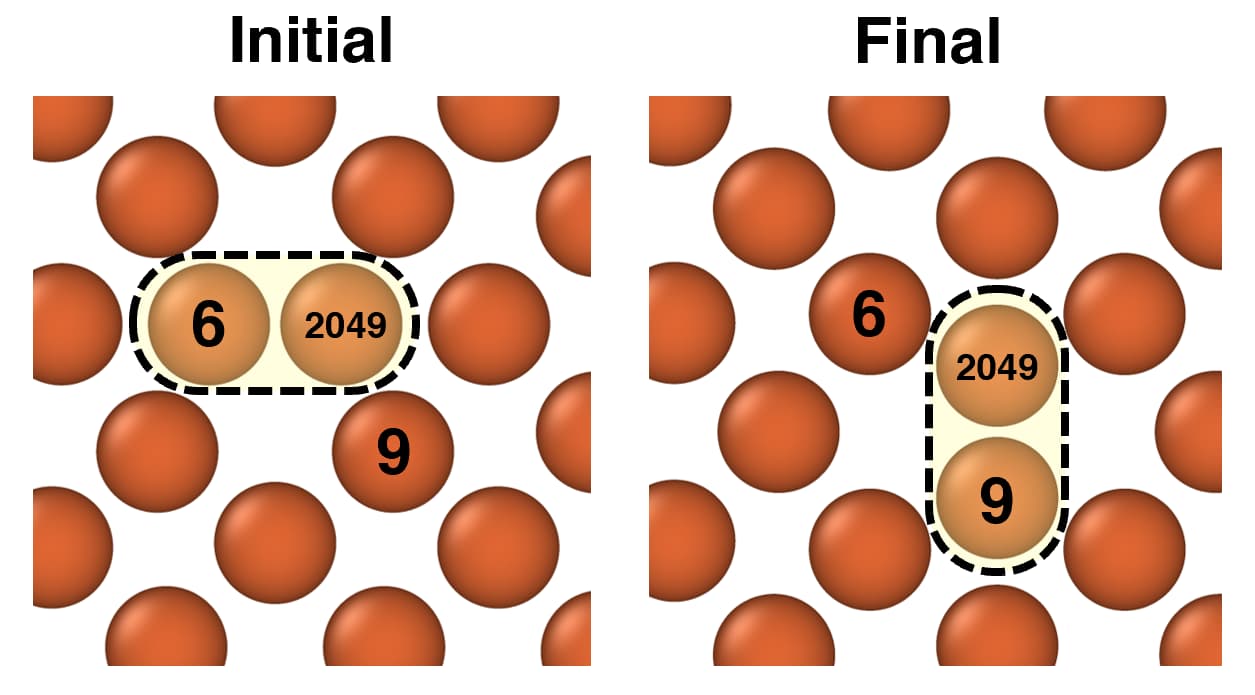
Then I am running NEB simulation with 12 partitions. I am using the following commands:
minimize 	1e-15 1e-15 5000 5000
fix			1 all neb 1
thermo		100
timestep	0.01
min_style	quickmin
neb			0.0 0.005 100 100 10 final final.txt
I am only taking the co-ordinates of the newly created interstitial Ni atom. The final.txt file -
1
2049 7.04 1.08236 28.16
I am using a 2048 atom system.
But I am getting near zero energy barriers (~3x10^-5 eV). This is the last line of the neb log file:
    Step     MaxReplicaForce  MaxAtomForce      GradV0         GradV1         GradVc          EBF            EBR            RDT            RD1            PE1            RD2            PE2            RD3            PE3            RD4            PE4            RD5            PE5            RD6            PE6            RD7            PE7            RD8            PE8            RD9            PE9            RD10           PE10           RD11           PE11           RD12           PE12
    223   0.0091862862     1.4465175e-05  5.6877652e-09  0.0052672766   0.0077208736   6.0790999e-05  3.1616739e-05  0.053057438    0              -9109.3035     0.31256984     -9109.3035     0.56451477     -9109.3035     0.68781715     -9109.3035     0.74024736     -9109.3035     0.76448997     -9109.3035     0.77446701     -9109.3035     0.77662467     -9109.3035     0.79635679     -9109.3035     0.84244947     -9109.3035     0.91348897     -9109.3035     1              -9109.3035
However, a literature that uses the same potential file that I am using, suggests that I should be getting an energy barrier of about 0.17 eV. Dumbbell rotation-induced interstitial migration energy of pure Ni is found to range from 0.1 to 0.2 eV in other literatures as well.
I have tried creating dumbbells in with different atoms and rotating it with their neighboring atoms. I have also tried making the initial and final configurations with out minimizing at the end, but it didn’t make any difference. Any assistance in solving this issue would be greatly appreciated.
Thanks,
Tawseef