Steve,
Thank you very much for your answers.
Now I want to move a cylindrical indenter in y direction (the indenter with the center axis in z axis). According to your answers and the manual, I still have some questions about this command.
-
You say that the indenter imposes a force on some subset of atoms that are close enough to it. The force on the indenter is simply the negative of the sum of those per-atom forces. Does it mean that:
the indenter imposes a radial repulsive force (F® = - K (r - R)^2) on the atoms with r<R. The sums of three components (x, y z) for these radial repulsive forces are the negatives of three components of the global force on the indenter, respectively. According to the manual, these three components of the global force can be output via thermo_style f_ID[1] f_ID[2] f_ID[3]. Am I right? -
The manual also says that the forces due to this fix are imposed during an energy minimization, invoked by the minimize command. For in.indent (not in.indent.min), there is not any energy minimization commands. I wonder how the forces due to this fix can be imposed?
-
Also this fix computes a global scalar energy. Is it the sum of the energy of each particle interacting with the indenter [as K/3 (r - R)^3 in manual]?
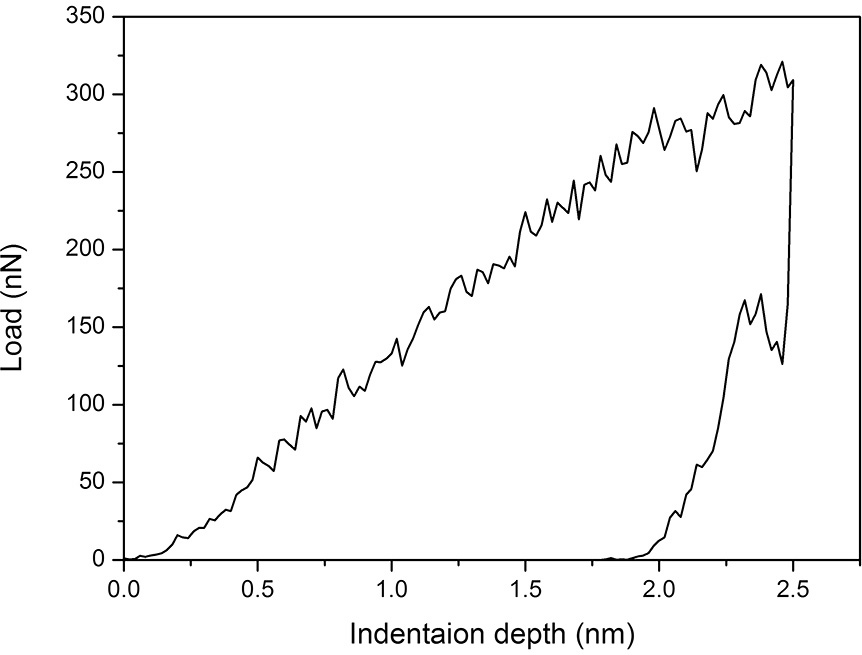
4.For the cylindrical indenter moving in y axis, can the load in the load–displacement curves be output as f_ID[2] directly, the sum of y component of these radial repulsive forces ?
Thank you.