We’ve recently pivoted the PWODE (PWave Orbit Density Engineering) project from image processing (our former V8 focus) to a highly specialized quantum spectral analysis tool. This shift has culminated in the release of PWODE V9.4, which leverages an unconventional computational method to process quantum band gap data with demonstrably superior results.
We’re starting this thread to open the model to material scientists and researchers in computational physics.
Key Computational Development: The Prime Resonance
The core of V9.4 is the application of prime number theory to the spectral analysis of electronic band structures. We are not suggesting a new physical fundamental; rather, we propose that the known mathematical distribution of primes offers a uniquely efficient basis for handling the non-linear complexity inherent in quantum spectra.
- The Problem: Traditional computational methods (e.g., DFT post-processing) for high-resolution band gap analysis often face limitations in speed or predictive accuracy when handling complex, non-periodic spectral features.
- The PWODE Solution (V9.4): We’ve demonstrated a verifiable “prime resonance”—a measurable correlation where prime number theory provides a superior computational tool for analyzing and interpolating quantum band gap data. This approach significantly reduces computational overhead and improves prediction quality compared to standard spectral decomposition techniques.
V9.4: Data and Scope
The current version, V9.4, extends our model from the initial V9.3 proof-of-concept.
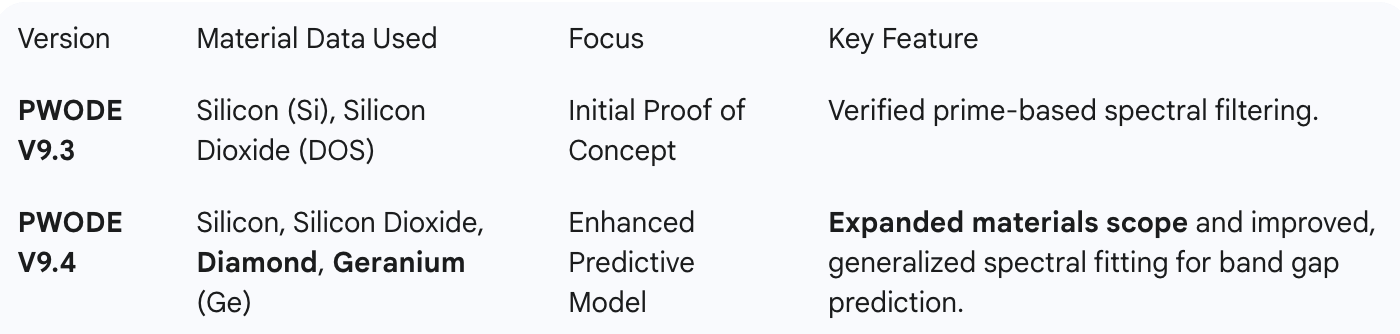
We specifically encourage researchers working with Group IV semiconductors and wide band gap materials to evaluate V9.4. The algorithm demonstrates particular utility in pinpointing subtle features within the conduction and valence band edges.
Next Steps and Collaboration
All our development and detailed documentation are hosted on GitHub. We invite you to clone the repository, test the V9.4 tools on your published data sets, and share your findings.
We believe PWODE V9.4 represents a genuine leap in spectral computational efficiency for solid-state physics. We look forward to your feedback and to discussing potential collaborative applications in this thread.