In short, mp-2636 I believe may have a badly calculated VRH value with no flags or warnings.
The supporting evidence I have for this is one literature reference on the MP page itself, one independent literature reference, and my own calculation via MP’s methodology with atomate2 and VASP.
Full details
For mp-2636, elasticity collection returns properties via API:
import os

from mp_api.client import MPRester

with MPRester(os.environ["MP_API_KEY"]) as mpr:
    d = mpr.materials.elasticity.search(material_ids=["mp-2636"])[0]

print(d.formula_pretty, d.state, d.warnings, d.deprecated, d.deprecation_reasons)
print(d.bulk_modulus, d.shear_modulus)
Gives:
Retrieving ElasticityDoc documents: 100%|█████████████████████████████████████████████████████████████████████| 1/1 [00:00<00:00, 16980.99it/s]
GdMg successful [] False None
voigt=216.967 reuss=216.967 vrh=216.967 voigt=26.763 reuss=17.079 vrh=21.921
KVRH is of interest, ~217GPa. No warnings or deprecation.
next-gen shows this as well:

MP reference
First literature result link

Has Table 1 list Bulk moduli obtained via Vinet EOS, row 10 is MgGd, approx 41 GPa.
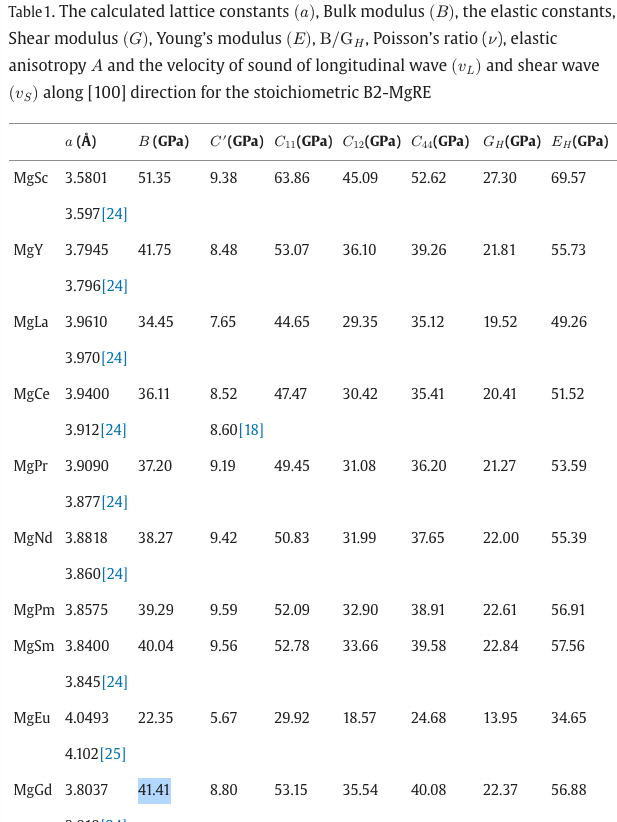
Second reference
Other publication, Table 1, using Murnaghan EOS, and with reference to other computational studies as well:
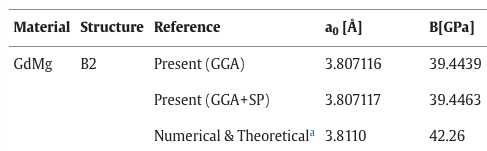
Seems to be around 39-42 GPa.
Independent Calculation
My own calculations with atomate2 0.1.5 , vasp cpu 6.4.2 using PBE and (as close as I can) same settings as MP with ElasticMakergive 40.6 GPa K VRH.
| Quantity | Value (GPa) |
|---|---|
| K_voigt | 40.605897791561 |
| K_reuss | 40.605897791560984 |
| K_vrh | 40.60589779156099 |
| G_voigt | 27.37425471370947 |
| G_reuss | 17.099528058221654 |
| G_vrh | 22.236891385965563 |
Full output store is attached.
mp-2636_elastic_pbe_output.json (37.6 KB)