Hello all,
I am executing a compression simulation on a multi-layered graphene-shaped model under a customized coarse-grained (CG) force field.
- The CG force field is simplified with almost bonded-interactions, such as harmonic bonds and angles.
- The compression simulation will lead to the in-plane deformation, shorten bond length and buckling.
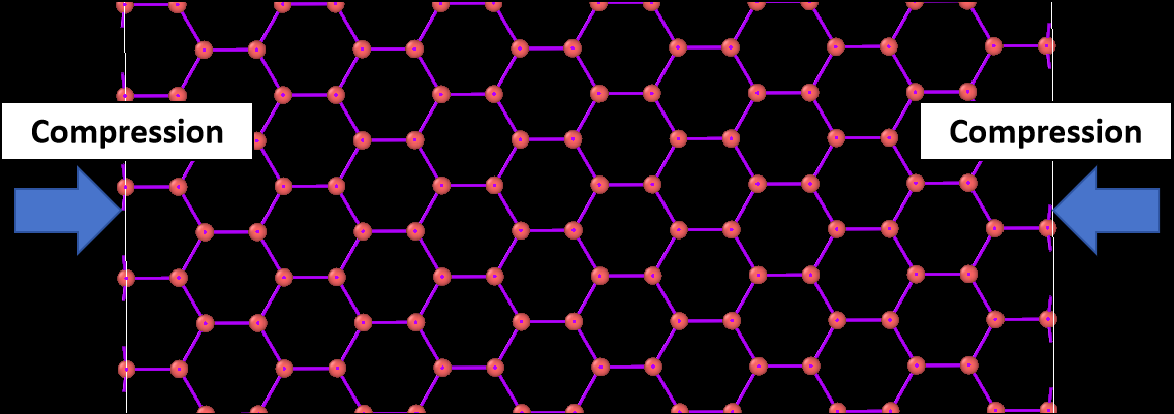
1. My goal and Problems facing to
I would like to fit the all-atom level compression strain-stress curve, which the strength will sharply reduce due to the compression failure.
However, I found the CG force field can’t reproduce all-atom level softening or failure behaviour under compression. A schematic of the performance is shown below:
- All-atom level model strength plunges after ultimate strain.
- Stress of CG model continues to increase, and no failure happens due to no bond cutoff or failure mechanisms for harmonic bonded interactions during compression.

2. Questions
I recognize the original harmonic bonded style is too simple to reproduce all-atom level performance, especially the failure behaviour. However, I can’t easily change the present CG framework. Based on this, I would like to ask:
- If there is any recommended command to change the bond behaviour by setting a threshold value. For example, when the bond length is shorter than the value, the bond would be deleted or softened, even though it may not follow real physics?
- (A similar command is bond/break, which can delete bonds going beyond a length. But it doesn’t work for shortened bonds)
3. About Attachment
I can provide more details if necessary.
Thanks for your help!