I am attempting to simulate a lipid vesicle using the 3-bead coarse-grained lipid model developed by Prof. Anand in Greg Voth’s lab (https://pubs.acs.org/doi/full/10.1021/ct300751h). While running a flat bilayer system under NPT conditions with a Langevin thermostat, the membrane remains stable and behaves as expected. However, when switching to a vesicle geometry and simulating under NVT conditions with the same Langevin thermostat, the vesicle becomes unstable — it either bursts or collapses into a flat bilayer with large holes.
I tried a similar approach with the Cook-Deserno 3-bead model and faced the same issue. Couldn’t find any repository for the files. Any suggestions to resolve this issue or improve the stability of the vesicle under NVT conditions would be greatly appreciated.
The following are the initial vesicle system with 9152 lipids and after 8 million steps
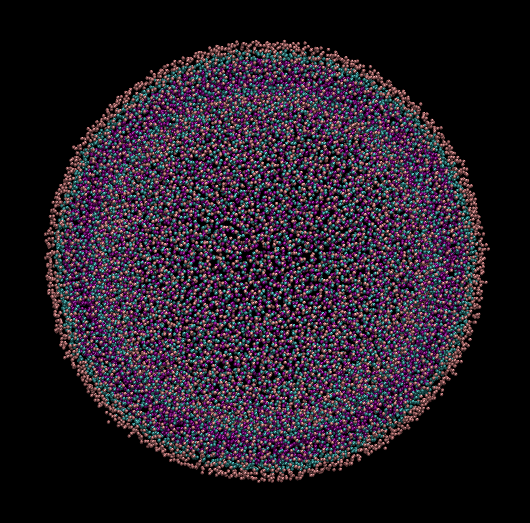
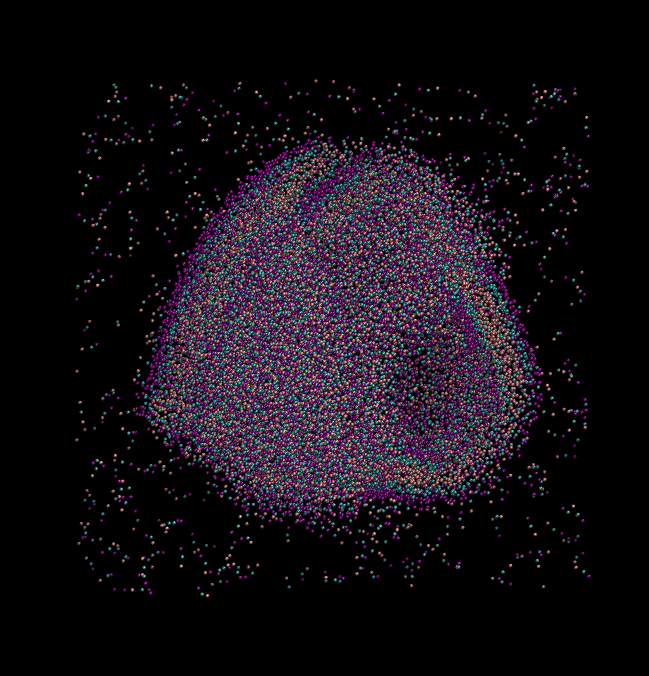
attaching the file used for my system
Lammps Input File Created for CG runs
variable output_freq string 1000
variable input string HCGBAR
units real
atom_style full
boundary p p p
read_data bilayer.data
pair_style hybrid/overlay table linear 200 #6040
bond_style harmonic
angle_style cosine/squared
dihedral_style none
improper_style none
mass 1 196.160 # name PCH
mass 2 311.440 # name MID
mass 3 278.524 # name TAIL
#pair_coeff * * lj/cut 0.0 0.0 20.0
pair_coeff 1 1 table TABLE/AA2.TAB AA 20.0
pair_coeff 1 2 table TABLE/AB.TAB AB 20.0
pair_coeff 1 3 table TABLE/AC2.TAB AC2 20.0
pair_coeff 2 2 table TABLE/BB3.TAB BB3 20.0
pair_coeff 2 3 table TABLE/BC.TAB BC 20.0
pair_coeff 3 3 table TABLE/CC3.TAB CC3 20.0
bond_coeff 1 10 7
bond_coeff 2 10 7.5
angle_coeff 1 100.0 150.0
velocity all create 300.0 4928459 rot yes dist gaussian
group headprot type 1 4:29:1
neighbor 2.0 bin
neigh_modify every 1 delay 10 check yes
comm_style tiled
minimizing initial system
minimize 1.0e-4 1.0e-6 1000 10000
thermo_style custom step temp pe etotal evdwl ebond eangle lx ly lz
thermo ${output_freq}
defining fixed and non-fixed atoms
group fixedatom type 1
group mobile subtract all fixedatom
applying force on fixed atoms
fix freeze fixedatom setforce 0.0 0.0 0.0
velocity fixedatom set 0.0 0.0 0.0
dump 6 all atom 10000 headprot_equi.lammpstrj
dump_modify 6 sort id
fix fxbal all balance 1000 1.05 rcb
running npt with fixed
fix nvtmobile_1 mobile nve
fix nvtmobile mobile langevin 300.0 300.0 100.0 3257
run 10000
unfix nvtmobile
unfix nvtmobile_1
unfix freeze
#soft equilibration
fix cg_langevin all langevin 300.0 300.0 1000.0 699483
fix nve_soft all nve/limit 0.01
restart 1000 restart
run 10000
unfix nve_soft
unfix cg_langevin
undump 6
reset_timestep 0
#thermo_style custom step temp pe etotal evdwl ebond eangle lx ly lz
#thermo ${output_freq}
dump 5 all atom 10000 headprot_0_50.lammpstrj
dump_modify 5 sort id
timestep 10
fix cg_lang all langevin 300.0 300.0 1000.0 699482
fix cg_nve all nve
restart 1000000 restart
run 10000000
#unfix cg_npt
unfix cg_nve
unfix cg_lang
undump 5